

Sapa Airport Transfer Cost: The Honest Answer Before You Land
Let me give you the number first, because that is what you came for. A Sapa airport transfer from Hanoi's Noi Bai Airport (HAN) typically costs between US$95 and US$220 for a private vehicle — that is roughly AU$145–340 or £75–175 for the whole car, not per person. A shared limousine seat runs about US$20–35 per person (around AU$30–55 / £16–28). Those are the real, all-in ranges for the 320 km, 5.5–6.5 hour journey — not a misleading "from" price designed to get you clicking.
Here is the part most websites bury: the price swings inside that range for very specific, predictable reasons — vehicle type, group size, time of day, season, and exactly where in Sapa you are going. From experience, the travellers who pay the top of the range are almost always the ones who didn't ask the right questions before arriving. The ones who pay fairly are the ones who got a fixed total in writing first.
Cheapest: shared limousine, ~US$20–35/person. Best value for couples & families: private sedan or SUV, ~US$110–180 for the whole car, door-to-door. Fastest & least stressful: any pre-booked private transfer (you skip the city entirely). The one to avoid: a random metered taxi from the airport rank — it is usually the most expensive and the riskiest. Book before you arrive, always get a fixed total, and you'll never see a surprise.
In this guide I'll break down every single option honestly — what it actually costs, what really happens at the airport, where the hidden fees hide, and which choice fits which kind of traveller. By the end you won't need to open another tab.
Sapa Airport Transfer Cost in Australian Dollars
For Australian travellers, the price often makes more sense when you see it in AUD instead of USD. Based on typical 2026 transfer ranges, a shared limousine seat is usually around AU$30–55 per person, while a private vehicle from Noi Bai Airport to Sapa is usually around AU$145–340 for the whole vehicle. That means two people may pay only a little more for a private sedan than for two shared limousine seats, while a family of four often gets better value from a private SUV.
| Option | Typical USD | Approx. AUD | Best Australian Traveller Fit |
|---|---|---|---|
| Shared limousine seat | US$20–35/person | AU$30–55/person | Solo travellers, backpackers, flexible couples |
| Private sedan | US$95–130/car | AU$145–200/car | Couples arriving after a long flight |
| Private SUV | US$120–170/car | AU$185–260/car | Families, older travellers, extra luggage |
| Private minivan | US$160–220/car | AU$245–340/car | Groups of 5–8, photography trips, multi-stop plans |
| Airport taxi | Unpredictable | Often poor value | Only if you accept price risk and no support |
If you land from Sydney, Melbourne, Brisbane or Perth after an overnight connection, the cheapest option is not always the best-value option. A shared limousine saves money, but a private transfer saves waiting time, luggage stress and the risk of being dropped at a meeting point instead of your hotel. For a full arrival-focused guide, see our Hanoi Airport to Sapa Transfer Australia guide.
Quick Price Comparison: Every Sapa Airport Transfer Option
Here is the whole landscape on one screen. Prices are realistic 2026 ranges for the full Noi Bai → Sapa journey. Per-vehicle prices are for the entire car regardless of how many seats you fill; per-person prices are for shared seats.
| Transfer Type | Typical Cost | Time | Comfort | Best For | Pros | Cons |
|---|---|---|---|---|---|---|
| Shared Limousine | US$20–35 / person | 6–7 hrs | Good | Solo & budget travellers | Cheapest; comfy reclining seats | Fixed schedule; may wait for other pax; multiple drop-offs |
| Private Sedan (4-seat) | US$95–150 / car | 5.5–6.5 hrs | Very good | Couples & solo who want privacy | Door-to-door; your own schedule; stop when you like | Dearer than a shared seat for one person |
| Private SUV (4–6 seat) | US$120–180 / car | 5.5–6.5 hrs | Excellent | Families & extra luggage | Space for bags & child seats; smoother on the mountain road | Higher fuel cost reflected in price |
| Private Minivan (7–16 seat) | US$150–260 / van | 5.5–7 hrs | Very good | Groups & multi-stop tours | Everyone travels together; cheap per head; can add stops | Overkill (and pricey) for just 2 people |
| Airport Taxi (rank/meter) | US$160–280+ / car | 6–7 hrs | Variable | Almost no one, honestly | Available on the spot | Often the most expensive; meter/price disputes; language barrier; no flight tracking |
| Train (via Lao Cai) | US$35–60 / person + transfers | 8–10 hrs total | Good | Travellers who want the rail experience | Sleep overnight; scenic; fun | You must first get into Hanoi, then transfer Lao Cai→Sapa; slow overall |
For one or two people on a budget, a shared limousine wins on price. For couples who value privacy, a private sedan is the sweet spot. For families and groups, an SUV or minivan is almost always cheaper per person than buying separate shared seats once you do the maths — and far more comfortable with luggage. The airport taxi rank is the one option that consistently disappoints.
Understanding the Route: Noi Bai → Hanoi → Expressway → Lao Cai → Sapa
Before we talk money, you need a clear picture of the journey, because the geography is exactly why the prices are what they are. Most first-timers picture Sapa as a quick hop from the airport. In reality it is a serious mountain journey, and understanding it will save you from a few classic mistakes.
Noi Bai Airport (HAN)
Noi Bai sits about 27 km north of central Hanoi. Here's the first thing most visitors get wrong: you do not need to go into Hanoi city at all. The expressway entrance is reachable directly from the airport side. A good private driver will skip the city centre entirely, saving you 1.5–2 hours of pointless traffic. If a quote routes you through downtown Hanoi "to pick up the car," that's a red flag.
The Hanoi–Lao Cai Expressway
This is the workhorse of the journey — a modern, mostly four-lane toll expressway that covers the bulk of the 320 km. On a clear run it's smooth and genuinely pleasant, with rest stops roughly every hour. The tolls are real and they're built into any honest fixed price. The expressway is why the trip is "only" 5.5–6.5 hours instead of the 9–10 hours it used to take a decade ago.
Lao Cai and the Final Climb to Sapa
Lao Cai is the lowland city near the Chinese border where the train terminates. Sapa is not Lao Cai — it's a further 35–40 km of winding mountain road that climbs to about 1,500 m. This last stretch is the slowest and most beautiful part, and it's also where the difference between vehicles shows. In a comfortable SUV the switchbacks are fine; in a cramped taxi with bad suspension they're miserable. If you're prone to car sickness, this is the section to take seriously.
Sapa makes its own weather. The town can be sunny while the mountain road in is wrapped in thick fog, especially in the wet season (roughly June–August) and on winter mornings. From experience, fog on the final climb can add 30–45 minutes and demands a driver who knows every bend. This is the single biggest argument against a random taxi driver who's never done the route.
Transfer Option #1: Shared Limousine (The Budget Choice)
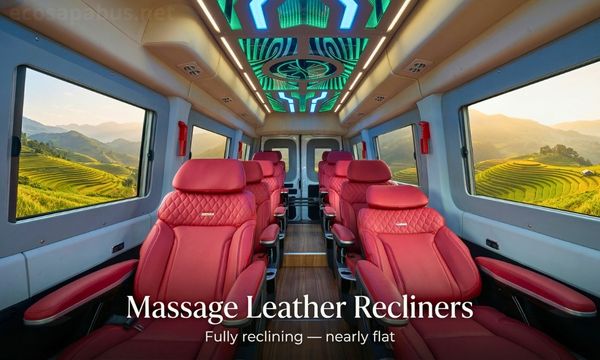
The "limousine" in Vietnam isn't a stretch limo — it's a converted 9–16 seat van fitted with big leather reclining captain's chairs, usually 7–11 of them with proper legroom. On a shared limousine you book a seat, not the whole vehicle.
How it actually works
You reserve one or more seats. The van runs to a schedule and collects other passengers along the way. On the airport version, your seat is held and you're picked up at a set time. At the Sapa end, the van does a loop dropping each passenger near their hotel.
What travellers expect vs. what actually happens
Most people expect it to feel like a cramped minibus. In reality the seats are genuinely comfortable — many recline almost flat, and the better operators give you a blanket and water. What surprises people is the logistics: because it's shared, you travel on the company's clock, not yours, and you may wait while the van fills or makes other drop-offs. On a tight arrival, that waiting can sting.
Real cost
A shared limousine seat costs roughly US$20–35 per person (about AU$30–55 / £16–28) for the full journey. For a solo backpacker, this is unbeatable value.
Who should use it — and who shouldn't
Use it if: you're solo or a budget couple, travelling light, flexible on timing, and happy to share. Avoid it if: you have small children, a lot of luggage, a tight connection, or you're arriving exhausted off a long-haul flight and just want to be driven straight to your door. Personally, if it were my first trip and I'd just flown 9 hours from Sydney or 13 from London, I'd pay the bit extra for private.
Transfer Option #2: Private Sedan (The Sweet Spot for Couples)
A private sedan (typically a 4-seat car like a Toyota Camry or similar) is the option I quietly recommend to most couples. You get the whole car, your own schedule, and a door-to-door run with nobody else aboard.
The airport pickup process
Here's what good looks like: your driver tracks your flight, so even if your Qantas or BA flight lands late, he's there when you actually clear customs. He waits in the arrivals hall holding a board with your name. He takes your bags, walks you to the car, and you're moving within minutes — no queue, no negotiation.
Cost breakdown
A private sedan runs about US$95–150 for the whole car (roughly AU$145–230 / £75–120). That total already includes the driver, fuel, expressway tolls and parking. For two people, that's often only a little more than two shared seats — but you get total privacy and control.
Real benefits
You leave when you want, stop for a coffee or a photo when you want, and you're dropped exactly at your hotel door. For a couple on honeymoon or a special trip, the privacy alone is worth it. From experience, this is the option with the fewest complaints.
Real drawbacks
For a single traveller on a tight budget, paying for a whole car is harder to justify than a $25 shared seat. And a standard sedan boot fits two large suitcases comfortably — if you're carrying three or four big bags, you want the SUV instead.
Transfer Option #3: Private SUV (Best for Families & Heavy Luggage)
If you're a family or you're travelling with serious luggage, an SUV (4–6 seats, something like a Fortuner or Santa Fe) is usually the right answer. The extra space changes the whole journey.
Why families choose it
The biggest reason is luggage and child seats. A sedan can't comfortably take two adults, two kids, a couple of big suitcases and a stroller — an SUV can. The higher ride height also smooths out the mountain switchbacks, which matters a lot when a toddler is dozing or someone's prone to car sickness.
Child seats
This is the practical one: Vietnamese taxis almost never carry child seats, and you can't rely on finding one at the airport rank. A pre-booked SUV transfer can have a child seat fitted and waiting if you ask when you book. Mention your children's ages and we'll sort it before you fly.
Comfort & cost
An SUV runs roughly US$120–180 for the whole vehicle (about AU$185–280 / £95–150), all-in. For a family of four, that's far better value than four shared seats — and incomparably more comfortable after a long flight with tired kids.
Transfer Option #4: Private Minivan (Groups & Multi-Stop Trips)
For a group of friends, an extended family, or a photography tour, a private minivan (7–16 seats) is the obvious pick. Everyone travels together, the per-head cost drops sharply, and you keep full control of the route.
Groups & friends
Six friends from California splitting one minivan pay far less each than six separate shared seats — and you actually get to travel together, which for a group trip is half the fun. There's room for everyone's bags without playing luggage Tetris.
Photography & multi-stop itineraries
This is where a private minivan shines. The Hanoi–Sapa road passes through some genuinely photogenic country, and a private driver will pull over at viewpoints, rice terraces or a roadside coffee on request. You can build a stop or two into the journey instead of just enduring it. From experience, photographers love this — the shared limousine simply won't stop for your shot.
Cost
A private minivan runs roughly US$150–260 for the whole van (about AU$230–400 / £120–215) depending on size and stops. Split among 7–10 people, the per-person cost is often the cheapest comfortable option of all.
Transfer Option #5: The Airport Taxi (An Honest Warning)
I'll be straight with you, because this is where I see travellers get burned most often. Grabbing a taxi from the Noi Bai rank for the full run to Sapa is usually the worst value of every option here — not the best.
The overcharging reality
Sapa is a 320 km mountain trip, not a city hop. Many airport taxi drivers either refuse the distance, quote an eye-watering flat fee on the spot (frequently US$160–280+), or start a meter that climbs alarmingly. Because you're tired, jet-lagged and have nowhere else to turn at 11pm, you're in the weakest possible position to negotiate.
- The "broken meter" line. The meter mysteriously isn't working, so it's a flat negotiated fee — always in the driver's favour.
- The mid-journey price change. A price is agreed, then renegotiated at a rest stop or as you reach the mountains. With your luggage in the boot, you have little leverage.
- The language barrier. Most rank drivers speak little English. Explaining a homestay address in Muong Hoa Valley at midnight is genuinely hard, and wrong drop-offs happen.
- No flight tracking. A pre-booked driver waits for a late flight. A rank taxi has no idea you're coming — if you're delayed, you simply arrive to chaos.
- Unknown vehicle condition. You don't know the car, the tyres or whether the driver has ever done the foggy mountain climb before.
When does a taxi make sense?
Honestly? Rarely for this route. A metered taxi is fine for a short hop within Hanoi, or from the airport to a city hotel. For the long mountain journey to Sapa, a pre-agreed fixed-price transfer beats it on price, safety and stress almost every time. If you remember one thing from this guide, let it be this.
Real Travel Scenarios: What Would I Actually Recommend?
Price ranges are useful, but nobody books transport as an average traveller. Your group size, luggage, landing time and energy level matter more than the headline price. These are the real situations we see every week.
If you are travelling light and watching the budget, a shared limousine around US$20–35 is sensible. The tradeoff is waiting time and less flexibility. If your flight lands late, check the last departure before relying on this.
Two shared seats can get close to the price of a private sedan. After a long flight, the private car usually feels worth it: no waiting for other passengers, no city pickup loop, and direct drop-off at your Sapa hotel.
This is where private transfer becomes the clear value winner. Four limousine seats plus luggage stress often cost almost the same as an SUV. Ask for child seats before you fly, not when you land.
The higher seat, easier entry and smoother luggage handling matter. I would not recommend gambling on an airport taxi after a long-haul flight. Book the vehicle, share the flight number and let the driver meet you properly.
If cost is the main priority and you are flexible, shared limousine is the direct cheap option. If you want the train experience, remember it ends at Lao Cai, not Sapa; read our Hanoi to Sapa train guide first.
One minivan keeps everyone together, lowers the cost per person and gives space for luggage. This is also the best setup if you want photo stops on the way into the mountains.
Shared vehicles will not stop for rice terraces, viewpoints or gear repacking. If Sapa is mainly for trekking and photography, connect your arrival transfer with your plan using our Best Sapa Trekking Routes for Beginners guide.
If your address is in Ta Van, Lao Chai or Muong Hoa Valley, do not book only to “Sapa town” unless you are happy arranging another vehicle later. Give the exact homestay link and confirm the final road is included.
One traveller = shared limousine is usually cheapest. Two travellers = compare shared seats against a private sedan. Three or more travellers = private SUV or minivan usually gives better comfort and often better per-person value.
The Hidden Costs Nobody Mentions
This is the section that separates an honest quote from a cheap-looking one. A "from US$80" headline can quietly become US$140 by the time you arrive. Here's where the extras hide — and what a proper fixed price should already include.
Airport waiting fees
If your flight is late and the driver waits 90 minutes, some operators bill for it. A good fixed-price transfer with flight tracking builds reasonable waiting in — ask explicitly.
Holiday & peak-season surcharges
Around Tet (Vietnamese New Year), national holidays and peak weekends, demand spikes and prices climb. This is real, not a trick — but it should be quoted up front, not sprung on you.
Night & early-morning surcharges
Many long-haul flights from Australia and the UK land late at night or before dawn. Some drivers add a night surcharge. Reasonable — but again, get it in the fixed total before you fly.
Luggage & extra-stop fees
Surfboards, oversized cases, an unplanned lunch stop or a detour to a second hotel can all attract add-ons with some operators. Tell us your bags and any stops in advance and we fold it into one price.
Hotel accessibility & "last mile" charges
Some Sapa homestays sit down narrow valley lanes a normal car can't reach. A cheap quote to "Sapa town" may not actually reach a Ta Van or Lao Chai homestay — and the last stretch becomes an extra. Always give your exact address when getting a price.
Driver, fuel, every expressway toll, parking, airport pickup with flight tracking, reasonable waiting for a delayed flight, and door-to-door drop at your exact address. If a quote doesn't clearly cover all of that, you haven't been quoted the real price yet.
Common Mistakes First-Time Visitors Make
After thousands of trips, the same avoidable mistakes come up again and again. Here are the big ones and how to dodge each.
- Assuming Sapa is close to the airport. It's 320 km and 5.5–6.5 hours. People book a 9pm transfer expecting to "pop up" and arrive shocked at 3am. Plan the journey, not just the flight.
- Confusing Lao Cai with Sapa. The train ends at Lao Cai — you're still 35–40 km and a mountain climb short of Sapa. Cheap "to Sapa" deals sometimes mean "to Lao Cai."
- Grabbing a taxi at the rank. The single most common — and most expensive — mistake. Pre-book instead.
- Trusting a "from" price. The lowest advertised number is rarely what you pay. Always get one fixed total for your exact trip.
- Routing through Hanoi city. If a quote sends you downtown first, you're adding 1.5–2 hours for nothing. Go airport → expressway → Sapa directly.
- Underestimating luggage. Booking a sedan then arriving with four big cases and a stroller. Match the vehicle to the bags.
- Forgetting child seats. They're almost never available on the spot. Request one when booking, with the child's age.
- Ignoring the weather window. Wet-season fog on the final climb is real and slows things down. Build in buffer; don't book a transfer that races a tight onward plan.
- Not sharing the exact hotel address. "Sapa" isn't enough for a valley homestay. Give the full name and location so the right vehicle is sent.
- Paying the full fare in cash up front to a stranger. With a reputable operator you confirm a fixed price first and there's no payment pressure at the airport. Never hand over everything before you've moved.
- Skipping flight tracking. If your transfer isn't tied to your flight number, a delay means you land to nobody waiting. Always confirm they track the flight.
Is Booking in Advance Worth It?
Short answer: almost always yes. Here's the honest reasoning rather than a sales pitch.
When you book ahead, three things lock in: the price, the vehicle, and the driver who's waiting for your specific flight. When you wing it at arrivals, all three become a gamble at the worst possible moment — late at night, jet-lagged, with limited English around you.
Peak season example
In peak months (March–May and September–November) and around holidays, the good vehicles get booked out. Travellers who leave it to chance either pay a premium for whatever's left or wait around. Booking even a few days ahead removes that risk entirely.
Weather example
When wet-season fog rolls onto the mountain road, you really want a driver who runs it daily — not whoever happens to be at the rank. Pre-booking lets you choose an operator who knows the route in bad conditions.
Flight-delay example
This is the clincher. A pre-booked transfer tracks your flight number. If your flight from Sydney or Heathrow lands two hours late, the driver simply adjusts — usually at no extra cost for a reasonable delay. A rank taxi has no idea you exist. Booking ahead turns a delay from a crisis into a non-event.
One sensible exception: if your flight lands very late and it's your first time in Vietnam, consider an overnight near Hanoi and a fresh daytime departure to Sapa. You'll travel the mountain road in daylight, rested, and actually see the scenery. We'll happily advise based on your specific arrival time.
Best Transfer Option by Traveller Type
- Lowest cost: ~US$20–35/person
- Comfortable reclining seats
- Best when travelling light & flexible
- Privacy & your own schedule
- Barely more than two shared seats
- Door-to-door after a long flight
- Room for luggage, strollers, child seats
- Smoother on mountain switchbacks
- Cheaper per head than separate seats
- Stop for viewpoints & rice terraces
- Full control of the route
- Shared vans won't pull over
- Top vehicle, best seats, water & wifi
- Flexible stops, total privacy
- Worth the premium for comfort
- Zero logistics, door-to-door
- Higher SUV seat is easier on knees
- English-speaking support throughout
- Everyone travels together
- Cheapest comfortable per-person cost
- Room for all the luggage
- Scenic, fun, sleep en route
- But: into Hanoi first, then Lao Cai→Sapa
- See our train guide for the full plan
20 Insider Tips From Local Experience
- ✅ Get a fixed total, not a "from" price — for your exact trip, with your exact address.
- ✅ Always confirm the price covers tolls, fuel, parking and waiting. The honest ones do.
- ✅ Give your flight number so the driver tracks it. A delay then becomes a non-issue.
- ✅ Skip Hanoi city — insist on the direct airport → expressway → Sapa routing.
- ✅ For two people, compare a private sedan against two shared seats — it's often close.
- ✅ Travelling with kids? Request a child seat in advance — they're not available on the spot.
- ✅ Heavy luggage or a stroller? Book the SUV, not the sedan.
- ✅ Give your full Sapa address — a valley homestay needs a vehicle that can reach it.
- ✅ Noi Bai has free wifi; you can message your driver on arrival without a local SIM.
- ✅ Grab a local eSIM anyway for the trip — handy, cheap, but not essential to meet your driver.
- ✅ Pack a light layer — Sapa is cool and damp even when Hanoi is hot.
- ✅ Prone to car sickness? Sit in the front, and take something before the final mountain climb.
- ✅ There are rest stops roughly hourly on the expressway — use them; the last stretch has fewer.
- ✅ Landing after midnight on your first trip? Consider an overnight near Hanoi and a daytime drive.
- ✅ Book your return leg too — pickup timed to your departure flight saves a second scramble.
- ✅ Withdraw some Vietnamese dong at the airport ATM for snacks and tips, even if you pay the transfer another way.
- ✅ Don't pay a stranger the full fare up front — reputable operators confirm price first, no airport pressure.
- ✅ In peak season book a few days ahead; the good vehicles sell out.
- ✅ Keep the operator's WhatsApp handy — it's the fastest way to reach them en route.
- ✅ Ask whether you can add a photo or lunch stop — on a private vehicle it's usually easy.
Plan What Happens After Your Sapa Transfer
The transfer is only the first part of the trip. Once you know your arrival time, plan the first 24 hours carefully: check-in, food, rest, trekking and weather all affect how good Sapa feels on day one.
Frequently Asked Questions
For a private vehicle, expect roughly US$95–220 (about AU$145–340 / £75–175) for the whole car, all-in. A shared limousine seat is about US$20–35 per person. The exact figure depends on vehicle type, group size, time of day, season and your precise Sapa address — so the most reliable approach is a fixed total quoted for your specific trip.
For one or two budget travellers, a shared limousine seat (~US$20–35/person) is cheapest. For families and groups, a single private SUV or minivan is usually cheaper per person than buying multiple shared seats — and far more comfortable with luggage.
A pre-booked private transfer with a driver who runs the route daily, tracks your flight, and knows the foggy mountain climb. You avoid airport haggling, mid-journey price disputes and unknown vehicle conditions.
A direct private transfer, around 5.5–6.5 hours door-to-door, because it skips Hanoi city and goes straight onto the expressway. The train is slower overall once you add getting into Hanoi and the Lao Cai→Sapa transfer.
For couples, a private sedan. For families and groups, a private SUV or minivan. For solo budget travellers, a shared seat. "Best value" depends on how many of you there are and how much luggage you carry.
Yes, almost always. Booking ahead locks in the price, the vehicle and a driver waiting for your specific flight. It's especially important in peak season, in bad weather, and if your flight risks delay.
With a fixed-price operator you agree one total in advance, so there's nothing to haggle and no surprises. Negotiating happens mostly at the taxi rank — and rarely in your favour when you're tired and have nowhere else to go.
For a long mountain journey, generally no. Common issues include refusing the distance, inflated flat fees, "broken" meters, mid-journey renegotiation, no flight tracking and a language barrier. A pre-booked transfer is more reliable on price and safety.
Yes — the expressway covers most of the route and experienced drivers run it in all conditions. That said, for a first visit after a long flight, an overnight near Hanoi and a daytime departure can be more pleasant. We'll advise based on your arrival time.
With a flight-tracked private transfer, the driver simply waits for when you actually land — usually with no extra charge for a reasonable delay. This is one of the biggest reasons to pre-book rather than rely on a rank taxi.
Demand rises in March–May, September–November and around holidays, so prices can be higher and good vehicles sell out. Book a few days ahead and you'll secure your price and vehicle either way.
Many reputable operators accept card or bank transfer as well as cash; arrange the method when you confirm your fixed price. Avoid handing a stranger the full fare in cash up front before you've even moved.
Yes — we quote and accept Australian dollars. Just tell us your preferred currency and we confirm the fixed total in AUD before you travel.
Yes — US dollars are widely accepted and we're happy to quote in USD. We can also quote GBP or Vietnamese dong; let us know what suits you.
About 5.5–6.5 hours door-to-door, covering roughly 320 km, mostly on the Hanoi–Lao Cai expressway. Heavy traffic leaving Hanoi or wet-season fog on the final climb can add a little time.
No. A good private transfer goes straight from Noi Bai onto the expressway toward Sapa, skipping the city entirely and saving 1.5–2 hours. Only detour into Hanoi if you actually want to stay there first.
Private transfers (sedan, SUV, minivan) are priced per vehicle, so the cost is the same whether one or several seats are filled. Shared limousine prices are per person.
Yes — homestays in Ta Van, Lao Chai, Muong Hoa Valley and beyond are reachable. Give us the exact address when you book so we send a vehicle suited to the final road in, with the price agreed up front.
Yes, on request. Mention your children and their ages when booking so we fit the right seat and send a suitable vehicle. Child seats are almost never available at the airport on the spot.
Lao Cai is the lowland city where the train terminates; Sapa is the mountain town about 35–40 km further on at ~1,500 m. A private car drives all the way to Sapa, with no separate transfer needed. See our Lao Cai to Sapa transfer guide for the rail route.
Yes — most travellers book both legs. Tell us your departure flight time and we time the Sapa pickup so you reach Noi Bai with comfortable margin for check-in.
The sooner the better, especially in peak season and around holidays. Message us as soon as you have your flight details and we'll lock in your fixed price and vehicle.
As a rough 2026 guide, shared limousine seats are about AU$30–55 per person, private sedans around AU$145–200 per car, SUVs around AU$185–260 per car and minivans around AU$245–340 per vehicle. The exact AUD total depends on exchange rate, vehicle type, pickup time and final Sapa address.
Often yes. Once you have three or four travellers, especially with luggage or children, a private SUV can be similar in total cost to multiple shared limousine seats while being much easier door-to-door.
Yes. If you arrive late or after a long flight, avoid booking an intense trek the same day. Use the confirmed arrival time to plan your Sapa schedule, especially if you want routes in Muong Hoa Valley, Lao Chai or Ta Van.
About Our Team & Why You Can Trust This Guide
We are EcoSapa Bus Official, based at 42 Hang Giay in Hanoi's Old Quarter. We have operated the Hanoi–Sapa route since 2015 and drive the Noi Bai Airport transfer daily, in every season and every weather. The advice here isn't scraped from other websites — it's what we see happen at arrivals and on the mountain road, week in and week out.
We've deliberately written this guide to be useful even if you never book with us. We'd rather you understand the real costs and avoid the taxi-rank trap than be left guessing. If you do want a hand, our English-speaking team replies quickly and gives straight answers.
Questions a webpage can't cover? Message the team directly on WhatsApp at +84 842 286 886 or email ecosapavipbus@gmail.com. We reply in English, usually within minutes.
Final Recommendation
If it were my first trip to Sapa, here's exactly what I'd do. I'd pre-book a private transfer with flight tracking — a sedan if travelling as a couple, an SUV if I had kids or heavy bags. I'd get one fixed total in writing, in my own currency, covering tolls, pickup, waiting and door-to-door drop-off. And I'd never walk up to the taxi rank to negotiate a 320 km mountain journey while jet-lagged at midnight.
That's not because private is always the "right" answer for everyone — a solo backpacker is perfectly served by a shared limousine seat. It's because the real cost of getting it wrong on this route isn't a few dollars; it's arriving stressed, overcharged, and shaken before your holiday's even started. Spend a little time getting the price fixed in advance, and the journey to Sapa becomes the easy, scenic start to the trip it should be.